

Book a Meeting
menu

Outsourced Accounting Services for USA Businesses & CPA Firms to Reduce Costs and Scale Efficiently

Aone Outsourcing Solutions is your global partner for bookkeeping, accounting, payroll, and tax support, built for U.S. businesses and accounting firms. Get intelligent financial management, streamlined operations, and expert guidance from professionals who understand your numbers and your goals.

  • icon 10,000+ Months of books completed on time
  • icon $4.2M+ In tax saving and deductions secured for clients.
  • icon 2,500+ clients and CPA firms in the U.S.

We deliver reliable outsourced accounting services for USA businesses and CPA firms—acting as a seamless accounting partner with US GAAP expertise, secure processes, and scalable offshore teams.

Free Trial

0

Centers

0

Expert Staff

0

Projects

0

Servicing

Tech-Driven Outsource Accounting Solutions that Scale with You!

Backed by industry-leading U.S. GAAP and IRS expertise, our accounting professionals use advanced technology to manage your entire back office from bookkeeping and tax compliance to receivables and payables, so that you can focus on scaling with confidence.

Payroll Services

Outsourced Payroll Services for U.S. Businesses

Bookkeeping Services

Professional Outsource Bookkeeping Services That Help USA Businesses Maintain Control

Accounts Receivable Services

Accounts Receivable Services for CPA Firms, Startups & Growing Businesses

Accounts Payable Services

Accounts Payable Outsourcing Services for CPA Firms & Businesses in the U.S.

Sales Tax Reconciliation Services

Sales Tax Reconciliation Services for USA Businesses

Tax Return Services

Outsourced Tax Return Services for USA Businesses

Year-End Finalization Services

Year-End Finalization Services for Growing Businesses in the USA

Industries We Serve

As each industry comes with its own tailored requirements

Because every industry has its own financial language and we’re fluent in all of them. From new startups to established professional CPA firms, Aone Outsourcing Solutions helps various industries manage their bookkeeping, accounting, payroll, and tax needs with precision, compliance, and strategy.

Consumer & Retail
Financial & Professional Services
Hospitality, Travel and Event
Real Estate & construction
Logistics, Transport & trade
Industries

Meet Our US-Focused Accounting, Tax & Payroll Team

We are an India-based accounting firm providing dedicated offshore support to US businesses and CPA firms. Our team is trained in US GAAP, IRS regulations, and multi-state payroll compliance. We support small and mid-sized businesses with bookkeeping, accounts payable/receivable, payroll processing, financial reporting, and CPA firm back-office services delivered through secure systems and structured quality controls.

Deepak Rajput
Deepak Rajput
Chief Executive Officer & Chief Marketing Officer

Poonam Rajput
Poonam Rajput
Chief Operating Officer

Bhavani Shankar
Bhavani Shankar
Chief Growth Officer

Indu Anandan
Indu Anandan
Chief Tax Officer

Michael Rafferty
Michael Rafferty
Advisor to CEO & COO

Bhaskar Mahajan
Bhaskar Mahajan
Senior Consultant – Assurance, Tax and Business Advisory

How Our Process Work

We have structured our process around constant monthly reporting since the first call, and our strategy is designed to be open, effective, and completely results-oriented.

Make a Discovery Call

Book a discovery appointment (free 30 minutes). No obligation, no compulsion, and simply a free discussion of your business and what you are in need of financially.

Free Consultation

Our team will give a deep analysis of your current financials, liabilities, and business goals-finding gaps, risks and opportunities that can make the needle move in the right direction of your firm or business.

A Well-Planned Strategy

We develop a customized engagement plan to the right services at the right level, with calendars to the IRS, federal and state tax calendar, and your reporting cycle.

Get Started Successfully

All your books, reports and communications will be available to you, with direct and easy access to your dedicated accountant whenever you need it, through your secure client dashboard.

Why Choose Us

We deliver excellence

We provide high-quality services with a focus on performance, reliability, and customer satisfaction.

icon

Extensive US Industry Experience

We have served the U.S. CPA firms and businesses over the years, knowing their operations, time limits, and client expectations, such that your accounting will always be smooth, every single time.

icon

U.S. GAAP, IRS Expertise

Our team of accounting professionals is highly knowledgeable in the U.S. GAAP, IRS requirements, and state regulations, providing you with the correct audit-aware financials you can count on.

icon

Dedicated Offshore USA Teams

Have a dedicated accounting team working as an extension of your own staff to provide consistency, accountability, and quality.

icon

Secure & Process-Led Delivery

Our better-organized procedures and secure systems safeguard your financial information throughout, including data security and quality measures.

icon

Scalable Support & Lower Costs

Scale up or down your accounting operations without requiring overhead, save money, and get qualified professionals.

Join Thousands of U.S. Small Businesses Who Trust Aone Outsourcing

Partner with Aone Outsourcing Solutions for accurate bookkeeping and accounting services built to meet U.S. GAAP standards. Simplify your financial operations, stay compliant, and gain the clarity you need to grow with confidence.

No obligation

Free 30 mins discovery call

Expert advice

Solution Oriented

Driving Results with The Best Technology

Our services are backed by top industry software to tackle every accounting and bookkeeping challenge.


brand
brand
brand
brand
brand
brand
brand
brand
brand
brand
brand
brand
brand
brand
brand
brand
brand
brand
brand
brand
brand
brand
brand
brand
brand
brand
Testimonials

Trusted by +2500 USA Small Businesses & CPA Firms

Client Testimonials

Insights & Updates

Blog
Aug 31, 2026
US Expatriation Tax Explained: Exit Tax Rules and Who Must Pay
The US Expatriation Tax is a federal taxation system that impacts US citizens who renounce their citizenship and selected long-term residents who give up their US residency. This guide outlines the US exit tax, rules and principles about covered expatriates, mark-to-market non-resident tax implementation under Section 877A, green card exit taxes, exceptions for dual citizenship, Form 8854 and significant tax considerations before expatriation. Moving abroad does not automatically trigger the US expatriation tax. The rules generally become relevant when an individual formally expatriates and must then be evaluated under the covered-expatriate rules. This guide explains who may be subject to the US exit tax, how the deemed-sale rules work, how different types of assets are treated, which exceptions may apply, and what individuals should consider before relinquishing US citizenship or terminating long-term US residency. It is intended to provide a clear overview of the rules and the factors that can affect an individual’s potential expatriation tax exposure. What Is the US Expatriation Tax? The US expatriation tax is a federal tax regime under Internal Revenue Code Section 877A that can apply to certain US citizens who relinquish their citizenship and certain long-term residents who terminate their US residency. It is usually referred to as the exit tax USA since it speeds up the taxation of unrealized profits for a covered expatriate upon exiting the US tax regime. Usually, the rule involves the mark-to-market principle. In essence, it implies that the property owned by a covered expatriate will be deemed disposed of for its fair market value before their departure. The ensuing gain or loss is calculated according to the provisions of Section 877A. The tax does not simply apply to everyone who moves abroad. First of all, one needs to expatriate in accordance with US tax rules, after which the covered expatriate criteria will be employed to apply Section 877A. US Expatriation Tax : Key Figures 2026 The most important figures for someone considering expatriation in 2026 are: 2026 rule Amount Net-worth test $2 million or more Average annual net income tax liability test More than $211,000 Section 877A net unrealized gain exclusion $910,000 These amounts should not be confused with a flat exit-tax rate. The $2 million figure is a covered-expatriate test based on net worth on the expatriation date. The $211,000 figure relates to average annual US net income tax liability for the five tax years preceding expatriation. The $910,000 figure is the 2026 exclusion used to reduce the amount of net gain otherwise includible under the mark-to-market rules.  These inflation-adjusted numbers may fluctuate yearly and, therefore, it is necessary for anyone thinking of leaving the country to check the appropriate figures for their specific year of emigration. Source: 26 CFR 601.602: Tax Forms and Instructions What Does It Mean to Expatriate? Expatriation is not the same as simply moving to a different country. For a citizen of the United States, expatriation involves giving up citizenship according to existing procedures. For those who are lawful permanent residents for an extended period of time, expatriation consists of ending residency in the United States for good. A person who leaves the US and relocates to Canada, the UK, France, or Germany, while retaining US citizenship has not automatically expatriated. US citizens usually continue to be subject to tax obligations in the US and have to report to US authorities. Green Card Exit Tax: When Does It Apply? The US expatriation rules can also apply to certain former green card holders. As per the US federal tax law and IRS Form 8854 provisions, a long-term resident (LTR) is basically an individual who has been a lawful permanent resident of the US for at least 8 years out of the last 15 tax years before the year in which such individual stops being treated as a lawful permanent resident. There can be some exclusions in the above-mentioned calculation, provided that the taxpayer was considered a resident in a foreign country based on an applicable tax treaty and did not choose to waive the right to claim treaty benefits. Therefore, giving up a green card does not automatically mean that the US exit tax applies. The first question is whether the individual is a long-term resident under the applicable rules. The next question is whether the individual is a covered expatriate. Who Is Subject to the Exit Tax? The exit tax USA generally focuses on covered expatriates. For expatriations occurring in 2026, an individual can generally fall within the covered-expatriate definition if any one of the following tests is met: Meeting one of these tests can be enough. You do not have to meet all three. Net Worth Test You generally meet the net-worth test if your worldwide net worth is $2 million or more on the date of expatriation. The calculation considers worldwide assets and liabilities. Depending on the individual, this can include: Liquidity is not the determining factor. Someone can have substantial wealth tied up in a private company or real estate and still meet the $2 million test. Valuing privately held businesses, trusts, real estate, and other difficult-to-value assets can therefore become an important part of expatriation planning. Tax Liability Test — $211,000 for 2026 The second test looks at the individual’s average annual net income tax liability for the five tax years ending before expatriation. For 2026, the applicable inflation-adjusted threshold is $211,000. This is a tax-liability test, not simply an income test. In other words, having income above a particular amount does not by itself mean the test is met. The calculation is based on the individual’s average annual net income tax liability under the applicable rules. Because this amount is adjusted for inflation, the threshold should be checked for the specific year in which expatriation occurs. Certification Test – Five Years of Tax Compliance The third test concerns tax compliance. An individual can be treated as a covered expatriate if they fail to certify on Form 8854 that they complied with all applicable US federal tax
Read More
Blog
Aug 25, 2026
Benefits of Mid-Size Accounting Firms in the USA (2026): Where Expertise Meets Affordability
The USA accounting environment has evolved significantly over the past ten years. Due to an increasingly data-driven, regulation-intensive, technology-oriented business landscape, a one-size-fits-all accounting model ceases to be effective. Scaling companies, SMEs, and startups require new accountants who know their business and can act quickly, providing regular advisory and consulting, not just mere compliance. This is precisely why accounting firms of a middle size have taken the lead. Small accounting firms offer personal service but have a weakness in capacity and specialization. Instead, large firms have vast resources but are costly, complicated, and too transient and set in stone to suit high-growth firms. In between these two extremes are the mid-size firms – the ideal mix of experience, technological advancements, and individual service. The benefits of mid-size accounting firms in the USA cannot be overlooked, as an increasing number of U.S. companies seek reliable firms to support their daily operations and long-term development. They are agile, provide better relationships, and are strategic, which is really important to contemporary businesses. Why Businesses Are Choosing Mid-Size Accounting Firms? Before delving into the details of specific benefits, one may want to know why companies are moving toward mid-sized companies at a rapid pace. The demands of accountants have also changed, and businesses seek more than a compliance partner; they want a strategic partner who will grow alongside the company. Evolving Needs of U.S. Businesses In recent years, U.S. companies have begun demanding much more specialized assistance from their accountants. They no longer desire laggard turnaround times, generic reports, or undefined pricing models. They seek, instead, industry expertise, expedited operations, transparent pricing, and long-term relationship management. Mid-size accounting firms have a natural fit with this change in expectations because they are both structured and flexible. Why Mid-Size Firms Fit Modern Business Expectations As business operations move faster, companies must have accounting partners who can keep pace. Mid-size companies provide focused teams, strategic contributions, and dynamism that are lacking in conventional structures. They offer a balanced experience that is equivalent to that of modern businesses without the heavy layers of larger companies or the constraints of small companies, providing efficiency, insight, and reliability. What Makes a Mid-Size Accounting Firm Different? To say more about the increasing popularity, it is better to examine what actually makes mid-size accounting firms special. They are placed in such a niche to enjoy the benefits of both small and large companies without experiencing their disadvantages. 1. Balance of Personalization and Professional Capacity A balance between personalized service and good professional capacity is one of the most significant reasons why companies prefer mid-size firms. They are large enough to handle complex financial requirements and small enough to give dedicated attention. Personalized Service With Direct Access to Senior Accountants Mid-size firms provide easy access to senior accountants, unlike large firms, where the business client is most likely to speak with a junior or assistant accountant. This not only quickens communication but also instills trust. Clients are familiar with the specialists handling their money, which leads to meaningful, long-term relationships. Larger Team Strength Without Bureaucracy Simultaneously, the teams in mid-size firms are larger and better-structured, as is the infrastructure, compared to those in small firms. This eliminates bottlenecks and guarantees faster delivery. They do not have to go through the red tape and multi-layer approval system of large companies, where decisions can take a long time to be made before they are implemented, and they can keep their production going. 2. Deep Industry Understanding In addition to providing regular accounting services, mid-size firms offer another benefit: specialization in a particular industry. This helps customers remain compliant, make sound decisions, and cope with the financial challenges specific to their industry. Niche and Sector-Specific Expertise Most of the companies in the mid-size category specialize in construction, healthcare, real estate, logistics, technology start-ups, and e-commerce. Through their extensive work in these niches, they become sensitive to general issues, reporting requirements, ents, and the possibility of using a fore, which is not always the case with the generic firms. Why This Matters for Compliance and Financial Decisions In the USA, not only the industry, but the state can be followed in terms of compliance. Under federal rules and in-house industry-related reporting cycles, mid-size companies are ahead of the curve by becoming familiar with all levels of these requirements. Their understanding of the sector would eliminate compliance risks, enhance tax planning, and improve the financial strategy. 3. Cost-Effective Without Compromising Quality Mid-sized companies are also likely to operate in specific sectors, which provides clients with the benefit of industry-specific compliance advice and highly relevant financial advice. Knowledge of industry norms, benchmarks, and regulations enables them to provide better forecasting and quality advisory care. Transparent and Predictable Pricing The pricing models used by mid-size firms are usually straightforward and consistent, which makes it easy for businesses to plan their expenditures. Companies enjoy simple billing mechanisms that reflect the actual work performed rather than overstated costs, unpleasant surprises, or exaggerated business charges. This openness creates confidence and helps clients achieve more stringent financial control. Ideal for SMEs and Scaling Companies Mid-size firms are very reliable because their operations are run by efficient teams and up-to-date systems, which keep costs affordable. This adds them to start-ups, small companies, and fast-growing businesses that need U.S. compliance, professional support, and advice without eating up operational budgets. 7 Key Benefits of Hiring a Mid-Size Accounting Firm Mid-size accounting firms offer a combination of skills and technology, along with the flexibility and custom attention that most U.S. ventures cannot find elsewhere. There are seven main advantages, as identified below. 1. Personalized, Relationship-Driven Service Mid-size companies provide a more connected and attentive experience through close working relationships with their customers. The professionals receive businesses and offer specific assistance, effective communication, and strategic expertise that understand their objectives, challenges, and day-to-day business activities. 2. Access to Experienced Professionals Mid-size firms are compared with small firms that have only a few people, or large firms where juniors
Read More
Blog
Aug 21, 2026
What Are Outsourced Bookkeeping ? Benefits, Costs & Process
Bookkeeping is a task every business needs, and almost no one enjoys doing. It’s manageable when your records are simple – but as a company grows, invoices, receipts, reconciliations, and tax deadlines start piling up until your books look like a mystery novel with chapters missing. Nobody starts a business because they’re excited about classifying expenses. That’s the main reason bookkeeping services have become the most in-demand and popular solution for business owners in the United States and worldwide. Instead of opening Excel files in the middle of the night or trying to find an accountant, companies delegate this responsibility to outsourcing teams. This guide covers what outsourced bookkeeping actually is, how it works day to day, what it costs in 2026, and how to choose the right provider – whether you’re comparing it against an in-house hire for the first time or already sold on outsourcing and just need to pick a partner. What Is Outsourced Bookkeeping? Outsourced bookkeeping means handing your day-to-day financial record-keeping to a team of external professionals rather than an in-house employee. It has been widely used in the USA, the UK, Canada, and Australia as companies search for better, more efficient ways of bookkeeping. The usual activities involved in outsourcing bookkeeping services are: This simply means you receive a similar or better standard of service to that provided by an in-house bookkeeper, without incurring expenses such as hiring and training personnel. Why Businesses Should Consider Outsourcing The reason why businesses should consider outsourcing:  Access to skilled experts You will have skilled bookkeepers who are familiar with the standards in the industry. They ensure your bookkeeping is up-to-date without any errors. Saves time and lowers your workload It allows you to spend your valuable time on your customers, operations, and growth because someone else is handling the bookkeeping. More cost savings than recruitment Outsourcing cuts the cost of salaries, benefits, training, and software. Businesses that switch from a full-time hire to outsourced bookkeeping commonly report savings in the 40–60% range — see the cost breakdown below for the sourcing behind that figure. No hiring or turnover issues You do not go through the entire process of recruitment, training and the possibility that you will lose your valuable employee halfway into the quarter. With a virtual team, you are not bound by one individual’s availability. Scales easily with your business Whether your transaction volume doubles or your business expands into new markets, support scales with you no extra recruitment or infrastructure required. Better accuracy and transparency in finances Proper reconciliation ensures that your books of accounts are accurate and up-to-date. Improved tax compliance You will not have problems with filing your taxes because your books of account are well-kept throughout the year. Advantages of Outsourced Bookkeeping Significant cost savings There is no cost for salaries, benefits, taxes, software, or training; only a monthly fee is required. Access to experienced experts You get immediate access to qualified bookkeepers already familiar with industry-specific compliance and reporting standards no learning curve, no supervision required to get there. Better accuracy and fewer errors An organised procedure, repeated checks, and modern accounting techniques help avoid repetition, incorrect classifications, and lost invoices. Scalable support as you grow Your provider adds resources as your transaction volume increases, without you needing to hire or lay off staff – ideal for fast-growing companies, seasonal businesses, or new-market expansion. Faster turnaround times Many outsourcing teams provide services on an extended or round-the-clock basis, which helps them process requests within a single day without any backlog. Better use of modern accounting technology You get access to current cloud accounting software and automation without paying for expensive licenses yourself – your provider handles integration, setup, and ongoing maintenance. Stronger data security Reputable outsourcing firms use secure portals, encryption, and strict access controls to protect your financial information – often to a higher standard than a small business could maintain internally. Reduced fraud risk If financial duties are distributed among several individuals rather than handled by a single internal bookkeeper, it is much more difficult for financial transactions to be tampered with. Improved cash flow insights Accurate books and regular reporting give you a clearer read on income, expense, and cash flow trends directly supporting smarter growth and spending decisions. How Much Does Outsourced Bookkeeping Cost? Outsourced bookkeeping pricing scales with what you actually need — you’re not paying for a full-time salary, benefits, or software licenses regardless of your transaction volume. Three factors mainly determine your price: business size, transaction volume, and reporting needs. Monthly Packages Based on Business Size The majority of outsourcing companies have tiered monthly fees. This model maintains predictability in costs as well as providing businesses the liberty to increase or decrease support as they develop. Hourly Pricing for Catch-Up or Special Tasks Not every engagement needs a monthly retainer. Hourly pricing — typically $20–$60/hour depending on complexity and experience required fits situations like: Overall Savings Compared to Hiring In-House According to the U.S. Bureau of Labour Statistics, the median annual wage for a bookkeeper or accounting clerk position is $49,210 as of May 2024 – that’s only base pay and doesn’t include any additional employment costs beyond that base rate. Outsourcing avoids all of those layered costs entirely. Multiple independent CPA-firm cost analyses put the resulting savings in the 40–60% range compared to a fully loaded in-house hire — a figure worth treating as a typical range rather than a guarantee, since actual savings depend heavily on your transaction volume and the provider you choose. You get full-time-equivalent bookkeeping support, current cloud-based software, and faster turnaround — without carrying the fixed cost of a full-time employee. That combination is what makes outsourced bookkeeping a cost-efficient option across business sizes. How to Outsource Your Bookkeeping (Practical Steps) 1. Initial Assessment & Onboarding Your provider reviews your existing books, identifies gaps, and learns your workflows setting expectations, reporting cadence, and secure channels for sharing documents and financial information. This builds a clean, organized foundation
Read More
Blog
Aug 17, 2026
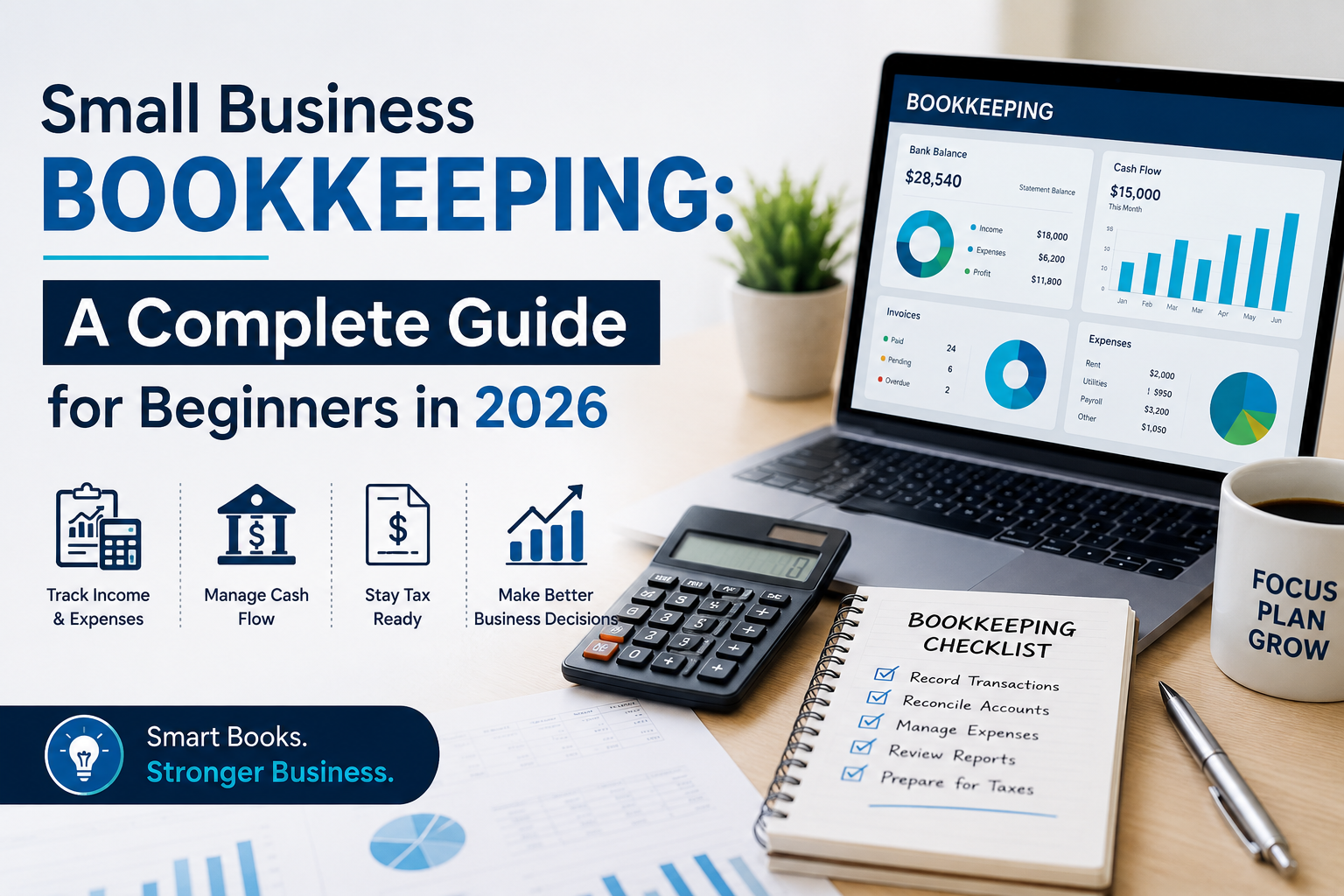
Small Business Bookkeeping: A Complete Guide for Beginners in 2026
Small business bookkeeping is the ongoing process of recording every dollar that moves through your company — sales, expenses, payroll, and everything in between. It matters because clean records are what make tax filing, financing, and day-to-day decisions possible. This guide walks through every method available for small business bookkeeping in 2026: spreadsheets, software like QuickBooks and Xero, freelance bookkeepers, and full outsourcing — with real 2026 pricing, current IRS requirements, and the signals that tell you it’s time to hand the work off to a service like Aone Outsourcing Solutions. What Is Bookkeeping? Bookkeeping involves systematically recording every single financial transaction that occurs in your business all the money that comes in and goes out of your business. Whether it is sales, expenses, payroll, returns and reimbursements or even payments on your loans everything is recorded and sorted out to create a financial record. It’s worth drawing a clear line between bookkeeping and accounting, because small business owners often use the terms interchangeably and they shouldn’t. Bookkeeping is the foundation: the daily and weekly act of capturing raw financial data. Accounting builds on that foundation — it’s the analysis, interpretation, and strategic use of that data to file taxes, create a growth plan, and make financial decisions. If your books are messy, your accountant’s job becomes harder and more expensive. If your books are clean, everything downstream — tax filing, financial planning, loan applications runs smoother. Why Do Small Businesses Need Bookkeeping? Here’s what most beginner guides won’t tell you directly: Poor bookkeeping is one of the leading reasons small businesses fail. Not because of bad products or weak marketing — but because owners lose visibility into their own finances until it’s too late. Clean, consistent bookkeeping does several things for your business simultaneously. Handing over clean books signals that you run a serious operation. And perhaps most practically for the day-to-day, it eliminates the annual tax season panic that so many small business owners know all too well. Bookkeeping Options for Small Business Owners There’s no single right answer here — the best approach depends on your business size, complexity, and how much time you can realistically dedicate to financial management. DIY with Spreadsheets works for very early-stage businesses a freelancer, a sole proprietor with a handful of monthly transactions. It costs nothing, but it scales poorly and leaves plenty of room for human error. (If this is where you are, our guide to single-entry bookkeeping walks through the simplest version of this method.) DIY with Bookkeeping Software is where most small businesses should start. Software such as QuickBooks, Xero and Wave helps to do most of the recording automatically, connects directly to your bank accounts and provides financial reports with minimal effort. This software is easy to learn and affordable. Hiring a Freelance Bookkeeper makes sense once your transactions grow in volume or complexity multiple revenue streams, contractors to pay, inventory to track. A part-time professional can handle your books on a weekly or monthly basis without the overhead of a full-time hire. Outsourcing to a Bookkeeping Service like Aone Outsourcing Solutions is the most scalable option for US small businesses. You get dedicated professional expertise, consistent accuracy, and full financial visibility at a cost that’s typically well below what a part-time in-house employee would run you. It’s also the option that frees up the most of your time and for owners specifically searching for small business bookkeeping services rather than software, it’s usually the right next step once DIY stops scaling. (See our full breakdown of what outsourced bookkeeping actually involves.) Software Comparison: QuickBooks vs Xero vs Wave Choosing the right software is one of the most consequential early decisions you’ll make. Each of these three tools dominates a different segment of the market for good reason. Feature QuickBooks Online Xero Wave Starting Price $35/month $15/month Free Best For Most US small businesses Scaling businesses, international Freelancers, solopreneurs Payroll Add-on Yes (built-in) Yes (add-on) Yes (paid) US Tax Integration Strong Good Basic Ease of Use Moderate Easy Very Easy Bank Reconciliation Yes Yes Yes IRS-Ready Reports Yes Yes Limited Mobile App Yes Yes Yes Accountant Access Yes Yes Yes Pricing verified against current 2026 rates. Both QuickBooks and Xero raised prices earlier this year, so budget for the current rate rather than older figures you may have seen quoted elsewhere. QuickBooks Online remains the gold standard for US small businesses. It integrates seamlessly with most US tax software, is most familiar to accountants, and offers the most robust reporting. However, on the downside, this system is neither inexpensive nor user-friendly, and its pricing has increased significantly in 2026. Xero should be the preferred software if your company is growing fast and you have international customers. It’s also become increasingly popular with bookkeeping professionals, which matters if you eventually outsource. Wave is legitimately excellent for what it is — a free tool for freelancers and very small businesses on the Starter plan. The drawback of this tool becomes evident when you want more sophisticated reports, better payroll functionality, or stronger tax integration capabilities – when the Pro edition ($19/month) starts to make sense. How to Do Bookkeeping for a Small Business: Step-by-Step Getting your bookkeeping right from the start saves you from expensive fixes later. These six steps form the foundation every small business needs. Step 1: Create a Bank Account for Your Business Before you record a single transaction, keep your finances separate. Every dollar is traceable and clean thanks to a specific business credit card and checking account. One of the most frequent IRS red flags is the mixing of personal and business funds, which is completely preventable. In addition to saving hours of untangling later, this step is free.  Step 2: Choose Your Accounting Method Either method – cash or accrual. Cash method records revenues when received and expenses when paid – simple and appropriate for most small businesses. The accrual method records revenues and expenses at the time they are earned or
Read More
Don't Miss These Important Deadlines…

Upcoming IRS Tax Filing Deadlines

Late filing could lead to fines and interest. We follow up each deadline to ensure that you are not in a hurry.

31 JAN 2026

File W-2s and 1099-NEC contractor income forms with the IRS and contractor recipients.

18 MAR 2026

Final date to file Form 1120-S and Form 1065, or request a 6-month extension.

15 APR 2026

Last day to submit personal income tax returns (Form 1040) and any amount of taxes due, or seek an extension.

15 APR 2026

Tax installment, first quarterly, estimated to be paid by individuals, self-employed and corporations.

15 JUN 2026

Second quarterly estimated tax payment that is to be paid by individuals and self-employed taxpayers.

Never Miss a Deadline Again

We track all compliance deadlines and lodge everything on time, guaranteed.

What services does Aone Outsourcing Solutions provide?
We offer end-to-end accounting, bookkeeping, payroll, and tax outsourcing services to businesses, CPA firms, and accountants.
How does outsourcing my accounting or bookkeeping work?
We start with a free consultation, onboard your accounts, and assign a dedicated accounting professional.
Who can benefit from outsourcing to Aone Outsourcing Solutions?
Startups, small businesses, and accounting firms across the globe benefit from our services.
Is my financial data safe with Aone Outsourcing Solutions?
Yes. We use encrypted file sharing and strict access controls to ensure data security.

Get In Touch

Have questions? Contact our support team for a quick response.

105 Queen Street Kingston, ON K7K 1A5 Canada

+91 9876543211

info@aoneoutsourcing.com